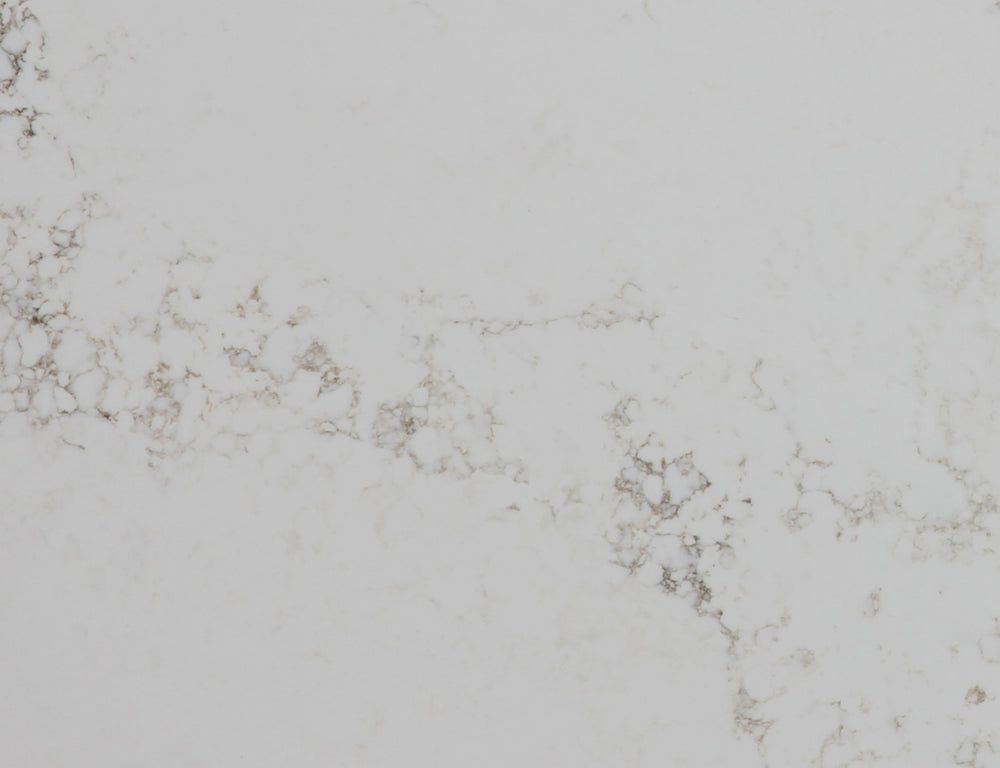
Quartz countertops feel like natural stone because, mostly, they are. Here's how raw minerals become the polished vanity top in your bathroom.
1. Sourcing the quartz
Quartz is one of the hardest, most abundant minerals on earth. Manufacturers source high-purity quartz, then crush and grade it, from fine powder up to coarse grains.
2. Mixing
The quartz is blended with a small amount of polymer resin and pigments, typically about 90% quartz and 10% binder. The recipe and blending technique create each design's color and veining. Premium brands like Cambria use proprietary processes to create natural-looking movement.
3. Vibrocompression
The mix is spread into a slab-sized mold and compacted under a vacuum with intense vibration and pressure. This removes air and produces the dense, nonporous surface quartz is known for.
4. Curing
Slabs are heat-cured in a kiln, which hardens the resin and locks in strength.
5. Gauging and polishing
The cured slab is ground to an exact thickness (3cm for Easy Bath tops), then polished with progressively finer abrasives to a mirror shine, or finished matte or suede.
6. Fabrication at Select Surfaces
That's where we come in. At Select Surfaces, your slab is cut to your exact dimensions on CNC equipment. The sink cutout is routed and polished, faucet holes are drilled, your chosen edge profile is shaped and polished, and the sink is mounted. Every top is inspected before it leaves our shop.